Showing posts with label Oceans. Show all posts

Tuesday, 2 July 2013

Michael's information report about Oil Spills

Oil Spills


Oil spills are a deadly mess that can kill many marine life. Oil spills are caused normally by ships crashing or breaking down.

Oil spills through a hole in the ship and floats on top of the water. This plots the water beneath. The oil can be many colors but when it comes out it is black.


Oil spills are caused in many ways. Some are caused by human mistakes or people being careless. Other ways are equipment breaking down, natural disasters such as hurricanes and storms. They can also be caused by terrorists, countries at war or illegal dumpers.


Oil Spills kill animals in many different ways. Birds get covered in oil and try to clean their feathers and die because the oil is poisonous. The oil can blind birds, which leads to them getting eaten by predators. Birds try to get food and then eats its prey with oil on it, causing the birds to be poisoned. Fish can get poisoned by the pollution that the oil spill causes.


Oil Spill affect the ocean by polluting the water, poisoning the animals that live in the water, and staining the coastline and killing the animals that live on the shore.
  

Oil Spills are awful messes I wish we could find a new way to make oil that is not poisonous.

Sunday, 30 June 2013

How to make a stuffed animal By Claire

How to make a stuffed animal!
Materials:
2 Sheets of A3 Paper                                    Scrap paper
Paint                                                             Shredded paper                                                     Scissors                                                        Stapler                                                       
A LOT of staples!

Instructions:
1.     Get your scrap piece of paper and sketch your animal. Keep practising until you think it’s the best it can be
2.     Once you are completely happy with your work, get one of your good pieces of A3 paper and draw your animal on to it
3.     Cut your animal out
4.    Trace around your animal onto the second piece of paper
5.     Cut the second animal out
6.     Paint both pieces of paper one colour all over. This is your base colour
7.     Let them dry then add any features you want your animal to have
8.     Once it is dry, staple the two pieces of paper together along the bottom of the animal
9.     Get your shredded paper and stuff as much as you can into your animal
10.   Staple up the rest of your animal
11.   Now you are done!  
By Claire

Thursday, 27 June 2013

Ocean Pals By Karen L

Our inquiry project right now is Oceans. I made a seal. We made these amazing pals by doing these steps.
You will need:
Shredded paper
Paint
2x A3 paper
Stapler and staples
How to make a Ocean Pal:
1.Choose an animal
2.Draw it out on an A3 piece of paper
3.Cut out your animal
4.Trace your animal on another piece of A3 paper
5.Paint your animals
6.Staple part of your animals together and leave a medium sized space
7.Stuff your animal with shredded paper
8.Staple the parts that you haven't stapled
Now you have the perfect Ocean Pal!

Wednesday, 26 June 2013

Monday, 24 June 2013

Dolphins

Dolphins are sea mammals. Almost all live in shallow tropical areas. Five types live in rivers. Some species of dolphins are endangered. There are up to 40 dolphins species are alive today.

Diet
Dolphins eat a variety of prey. Dolphins eat fish, squid and other types of sea animals. How much a dolphin eats depends on the size of its prey. Dolphins use different strategies to catch prey. They use methods like herding fish. Some strike fish with their tails (it is called whacking).

Behavior
Dolphins are very playful. Many species will leap out of the water to look at their surroundings. Dolphins sometimes follow ships in packs.

Habitat
Most Dolphins live in shallow tropical waters. Five types live in rivers. River dolphins are called platanistidae and ocean dolphins are called delphinidae. Dolphins live in every ocean, although mostly in warm waters.

Features
Dolphins have little hairs around their jaw when they are a calf (newborn). As they get older, they fall off. Dolphins are part of the cetacean family. Most dolphins have long, light bodies that are made for fast swimming and high jumps out of the water.

Facts:
There are around 35 to 40 types of dolphins that are known, though several species are known to be endangered.
Dolphins live in groups from five to several hundred.
Dolphins swim up to a hundred miles a day.
Dolphins sleep with one eye open.
Dolphins have been known to dive down to depths of 1,700 feet.
Dolphins can swim between 20 to 25 miles per hour.


By Georgia


Room 5 has been creating 3D sea animals. I made a shark. We painted on a shape of an animal and then waited till it dried and then we stuffed it with ripped paper.

By Joe

Thursday, 20 June 2013

Jasmine's Bottlenose Research


Bottlenose Dolphins

Dolphins are well known by their intelligence and their kindness. Their mouths are curved to show their appearance of friendliness, and they can also be trained complex tricks to perform.

Bottlenose Dolphins can swim 18 miles per hour. To breath they swim to the surface for 2-3 every minute. Schools of Dolphins would come to aid an injured Dolphin by bringing it to the closest shore.

Bottlenose Dolphins track their prey through the use of echolocation to find out where the prey is and how big it is. They can make nearly 1,000 clicking noises every second. The sounds they make to find food travels underwater until it meets their prey, then it bounces back to the Dolphin who sent the sound and the Dolphin finds out their prey's location, size and the shape of their prey. When they are feeding, they often eat bottom dwelling fish. They also eat shrimps and squids.

These Dolphins can be found in tropical oceans and other warm waters surrounding the earth. They are scattered around the world in oceans. They avoid the Arctic oceans in the north and also the Antarctic ocean down south, where the water starts to get cold.

Dolphins travel in groups and communicate by squeaks and whistles. They are sometimes spotted following fishing boats in hopes of the fisherman's dinner leftovers. 

Once Dolphins were widely hunted for meat and oil. Today limited Dolphin fishing takes place. They are being threatened because of commercial fishing for other sea animals. They can also become tangled in fishing nets and other fishing equipment, which leads to their death.


Fast Facts about Bottlenose Dolphins:
They are: Mammals
They are: Carnivores
Their size is: 10-14 ft
Their weight is: about 1,000 lbs

Did you know?
Dolphins sleep with one of their eye open and the other closed.
To stop drowning, dolphins keep ½ of their brain awake and the other ½ sleeping so they can continue breathing.

By:Jasmine

Wednesday, 19 June 2013

Stuffed Seal by Gina


Room 5 made sea creatures that we stuffed with shredded paper.
I made a Seal that was painted with brown and the head painted with white.
Hope you like it!!!

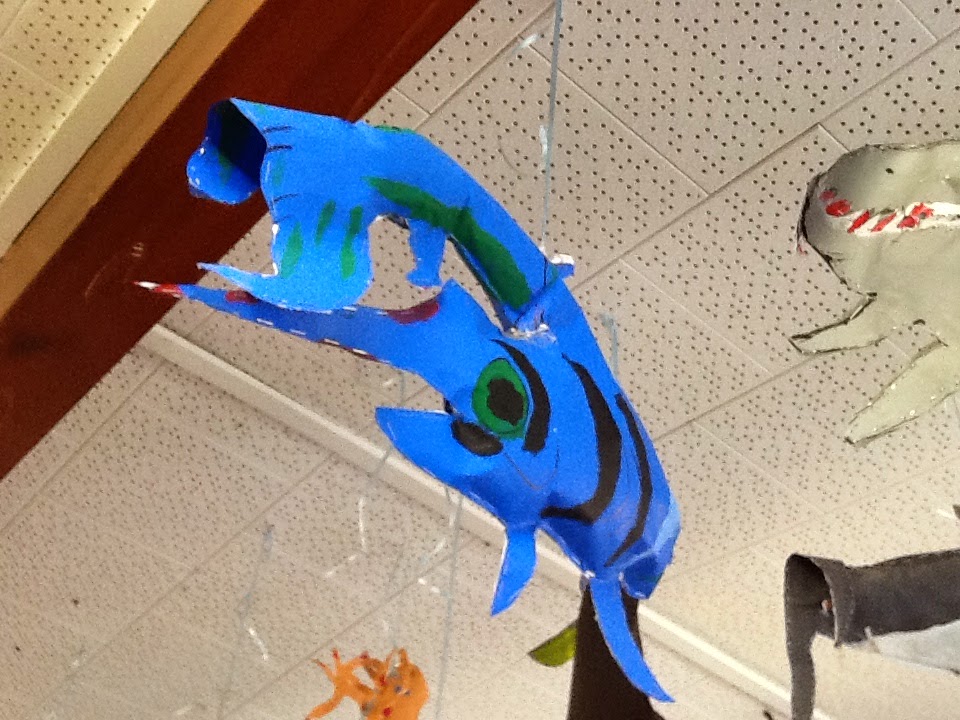
Yuan's Stuffed Swordfish

This is my stuffed swordfish:


I really like my stuffed sea animal because it is huge and awesome.
From Yuan

Tuesday, 18 June 2013

Rose's Information Report

Hector's Dolphins

Did you know that Hector's dolphin is one of the smallest dolphins in the world? They live around the West Coast and Christchurch in the South Island of New Zealand.
The Hector's dolphin is so small that one could fit in a bathtub! They grow between 1.2 to 1.4 metres. The female weighs up to 45 kilograms and the male weighs about 10 kilograms less.
Catching food takes most of the dolphin's day up. They mainly eat red cod, flounder, hake and stargazer.
The Hector's dolphin is a small gray, white and black dolphin. They are mostly gray with a white belly and black face, tail and fins.
 
Did you know the population has fallen from 30,000 to 7,000? Their population has declined because of  rubbish in the sea. The dolphins see the rubbish and think it is food, or they get tangled in the rubbish and cannot swim or feed properly. Without being killed by rubbish, the Hector's dolphin can live up to 20 years.
Hector's Dolphins are the rarest dolphins in the world. They can only be found in New Zealand and their numbers are getting very low. I think Hector's dolphins are very special and should be saved. What do you think?   

My Jellyfish

This is my jellyfish.
 Room 5 did stuffed animals
I did a stuffed jellyfish
It was great fun
We painted and cut, scribbled and rubbed!


By  Isabelle

Monday, 17 June 2013

Thursday, 13 June 2013

Jellyfish by Alice


We made a jellyfish in a bottle!
You will need:
Plastic bag
Scissors
String
Bottle
Dye

Instructions:
Get your plastic bag and cut it in half
Poke your finger through but don't make a hole
Hold it tight
Tie a knot around it but leave a small hole
Fill it half way up with water
Fill the bottle with water and add dye
Put the jelly fish in the bottle


Helena's 3D dolphin


This term our class made 3D animals. 
I made a Dolphin. Is it amazing.
If you want to make a 3D ocean animal this is what you need:
two big pieces of paper
Scissors 
Pencil 
Stapler 
Paint
Cut  paper

First draw a ocean animal then draw another one next we paint one main colour over the animal.
Then paint the details on it with a paint brush. After stapler the sides and leave a big gap. After then staple it then u are done. 


Wow Alive Jelly fish! By Karen L and Claire

WOW! Alive Jelly Fish!
On Monday the 27 May we made a jelly fish in a bottle. Now we will teach you step by step how to make a jelly fish that looks alive.
You will need these everyday products:
Scissors
Clear plastic shopping bag
Clear drink bottle that is not going to be used anymore
Blue food colouring or blue dye
Water
Fishing string
How to make it:
1.First you cut a plastic bag in half
2. Second you put your first finger in the middle of the half plastic bag
3. Blow in the the hole where your first finger was
4. Tie the string in under the hole but don't make it so tight because you need to put water in it
5. Put water in the jelly fish and the bottle only put two thirds of water into the bottle
6. Now put the dye into the bottle but not the jelly fish
7. Put the jellyfish in now and you are DONE!
This is the finishing result!

Monday, 10 June 2013

Jellyfish in a bottle by Isabelle

How To Make A Jellyfish In A Bottle. 


you need:
~ half of a clear plastic shopping bag
~clear plastic bottle
~scissors
~blue dye
~string
~water


1. get half of your shopping bag and stick your finger through the middle

2.blow air into it and tie it but make sure there is space
3. start cutting your tentacles the less tentacles the better .
4.put a little bit of water into the head make sure there is air and tighten it.
5. put water and blue dye into the bottle make sure if you have at least
an inch of air in it.
6.put the jellyfish in and tighten the bottle and look at it go


Sunday, 9 June 2013

Information Report about Swordfish

Information Report about Swordfish


The swordfish are cold blooded marine animals. They are a large and strong animals. Their scientific name is Xiphias Gladius. The swordfish is one of the world's fastest sea animals as they can swim up to 50 miles per hour. They are rare animals too.

The swordfish sometimes lives in the Pacific Ocean, Indian Ocean and Mediterranean Sea (Under Europe). The north-west Atlantic Ocean is also their habitat. The Pacific swordfish are three times larger than north- west Atlantic swordfish.

The swordfish have a long flat sharp bill above their mouth to catch their prey and protect from predators (enemies) including humans, large sharks and killer whales. They have a couple of big eyes and no teeth. The swordfish have a crescent shaped tail and a tall front fin. They have a special organ near their eyes which keeps their eyes and brains warm which makes them think and see better. Their average length is 2.1 metres, but some of the swordfish reach 4.6 metres! Most swordfish weigh 68 - 113 kgs. They can weigh more than 450 kg and the world's heaviest swordfish ever caught weighed 536 kgs! The female swordfish are bigger than the males. 

Swordfish are carnivores (that means meat-eaters). They eat ocean fish like mackerel, hake, herring and bluefish. They sometimes eat octopus and squids. They mostly eat at night. They catch food with their bills. 

Some swordfish die of pollution that made them think it's their food but it is actually rubbish. If they don't die from pollution, their average lifetime is three or four years and the maximum is 9 years.


The swordfish are very interesting and fun animals. You might want to see one at an aquarium!

By Yuan

Thursday, 6 June 2013

Making Jellyfish by Rose

Jelly fish


In Room 5 we have been studying the sea. We have learned that turtles sometimes mistake plastic bags for  jellyfish. Now we have made plastic bag jellyfish we can see why turtles think they're jellyfish.

This is how we made a jellyfish in a bottle…
  1. Cut a plastic bag in half and cut the handles off
  2. Put your finger in the middle and flip it upside down so it is on top of your finger
  3. Slide your finger out and tie some string around the neck, but not too tight that you can’t get any water in
  4. Pour a little bit off water into the head of the jellyfish, so it fills the top half and then pull the string so the water can’t escape.
  5. Get a clear bottle and fill it up to the top with water and then put a pinch of blue food colouring in.
  6. Get your jelly fish and put them in the bottle
  7. Put on the lid and then have fun! Turn the bottle upside down and watch your jellyfish floating around like a real jellyfish!
Here is a video to show you what to do: